
Jenkins – Pipeline Retry Strategy Using Self-Rebuild and Shared Library
Overview
In modern CI/CD environments, especially those with strong dependencies on external services (APIs, networks, third-party systems), transient failures are inevitable. Retrying failed pipelines becomes essential to improve reliability and reduce manual intervention.
This article presents a robust and production-ready retry strategy for Jenkins pipelines, based on:
- Self-triggered pipeline re-execution
- Parameter propagation across builds
- Controlled retry logic via Shared Library
- Compatibility with dynamic parameters (including Active Choices)
The solution ensures deterministic retries while preserving execution context.
Quick Summary
Advantages
- Fully automated retry mechanism (no manual intervention)
- Preserves all parameters across retries
- Deterministic and reproducible executions
- Stateless design (no dependency on previous workspace)
- Works with dynamic parameters (Active Choices, Reactive)
- Centralized logic via Shared Library
- Clear and traceable build history (each retry = new build)
Disadvantages
- Re-executes the entire pipeline (including successful stages)
- No re-evaluation of dynamic parameters (Active Choices)
- Requires explicit parameter propagation logic
- Potential for overlapping builds if concurrency is not controlled
- Slight delay overhead (sleep + scheduling)
When This Approach Is Useful
This retry strategy is particularly beneficial in scenarios such as:
External Dependency Instability
- APIs with intermittent failures
- Third-party services with rate limits or timeouts
- Cloud provider transient issues
Network-Sensitive Pipelines
- Artifact downloads (S3, Nexus, Artifactory)
- Git operations under unstable connectivity
- Remote deployments over SSH
Flaky Test Environments
- Integration tests with external systems
- End-to-end tests with shared environments
- Race conditions in distributed systems
Long Pipelines Where Manual Retry Is Costly
- Complex CI/CD pipelines
- Multi-stage deployments
- Pipelines triggered overnight or unattended
Stateless Build Environments
- Ephemeral agents (Kubernetes, cloud runners)
- Non-persistent workspaces
- Immutable infrastructure setups
Core Concept
Instead of retrying individual steps or stages, this approach:
Re-executes the entire pipeline as a new build, preserving the original parameters.
This is functionally equivalent to a manual “Build Again”, but automated, controlled, and consistent.
Architecture
The solution is composed of two main parts:
- A Shared Library function (
retryPipeline) - A pipeline that invokes it in
post { failure }
Shared Library Implementation
def call(Map config = [:]) {

    int maxRetries = config.get('maxRetries', 3)
    int baseDelaySeconds = config.get('baseDelaySeconds', 60)

    int currentRetry = 0

    if (params.containsKey('RETRY_COUNT')) {
        currentRetry = params.RETRY_COUNT.toString().toInteger()
    }

    // Avoid retry on manual abort
    if (currentBuild.rawBuild.getResult().toString() == 'ABORTED') {
        echo "Build was aborted. Skipping retry."
        return
    }
    echo "Internal retry count: ${currentRetry}"

    if (currentRetry < maxRetries) {

        int nextRetry = currentRetry + 1
        int delaySeconds = baseDelaySeconds

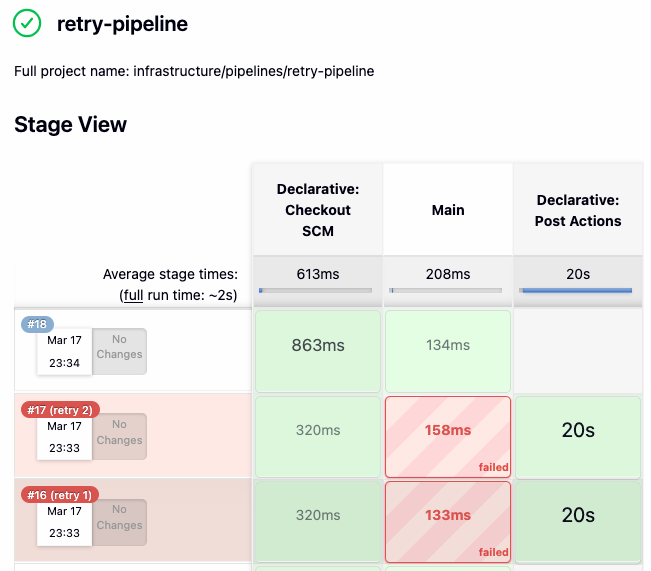
        currentBuild.displayName = "#${env.BUILD_NUMBER} (retry ${nextRetry})"

        echo "Retry ${nextRetry}/${maxRetries} in ${delaySeconds} seconds..."

        sleep time: delaySeconds, unit: 'SECONDS'

        // Propagate parameters
        def currentParams = params
            .findAll { key, value -> key != 'RETRY_COUNT' }
            .collect { key, value ->
                if (value instanceof Boolean) {
                    return booleanParam(name: key, value: value)
                } else {
                    return string(name: key, value: value.toString())
                }
            }

        currentParams += string(name: 'RETRY_COUNT', value: "${nextRetry}")

        build job: env.JOB_NAME,
              parameters: currentParams,
              wait: false

    } else {
        echo "Max retries reached (${maxRetries}). Not retrying."
    }
}Example Pipeline
@Library('devopsdb-global-lib') _

def default_maxRetries = 3
def default_baseDelaySeconds = 20

properties([
    parameters([
        string(name: 'ENV', defaultValue: 'dev'),
        booleanParam(name: 'RUN_TESTS', defaultValue: true),
        choice(name: 'REGION', choices: ['eu-central-1', 'eu-west-1', 'eu-north-1']),

        [$class: 'CascadeChoiceParameter',
            name: 'SERVICE',
            choiceType: 'PT_SINGLE_SELECT',
            script: [
                $class: 'GroovyScript',
                script: [script: "return ['payments','billing','orders']", sandbox: true],
                fallbackScript: [script: "return ['fallback']", sandbox: true]
            ]
        ],

        [$class: 'CascadeChoiceParameter',
            name: 'ENDPOINT',
            choiceType: 'PT_SINGLE_SELECT',
            referencedParameters: 'REGION',
            script: [
                $class: 'GroovyScript',
                script: [script: """
                    if (REGION == 'eu-central-1') {
                        return ['api.prod.local', 'api2.prod.local']
                    } else {
                        return ['api.dev.local', 'api2.dev.local']
                    }
                """, sandbox: true],
                fallbackScript: [script: "return ['fallback-endpoint']", sandbox: true]
            ]
        ]
    ])
])

pipeline {
    agent any

    stages {
        stage('Main') {
            steps {
                script {
                    echo "=== PARAMETERS PRINTS ==="
                    params.each { k, v ->
                        echo "${k} = ${v} (type=${v?.getClass()?.getName()})"
                    }
                    if (params.RETRY_COUNT.toInteger() < 2) {
                        error "Failing on purpose (simulate flaky dependency)"
                    }
                }
            }
        }
    }

    post {
        failure {
            retryPipeline(
                maxRetries: default_maxRetries,
                baseDelaySeconds: default_baseDelaySeconds
            )
        }
    }
}Source: https://github.com/faustobranco/devops-db/tree/master/infrastructure/pipelines/retry-pipeline
How the Retry Mechanism Works
- Initial build starts with
RETRY_COUNT = 0 - On failure,
post { failure }triggers the retry - Shared Library:
- increments retry counter
- waits (
sleep) - triggers a new build
- All parameters are copied and passed forward
- New build runs from scratch
Parameter Propagation Explained
Jenkins does not automatically pass parameters between builds.
This solution explicitly:
- Reads current
params - Recreates them (
string,booleanParam) - Overrides
RETRY_COUNT - Passes them to the next build
This guarantees:
- identical inputs
- no fallback to defaults
- consistent execution
Design Philosophy
A retry must reproduce the same execution context, not recompute it.
This means:
- No dynamic parameter recalculation
- No dependency on UI logic
- No reuse of previous workspace
Conclusion
This retry strategy provides a robust and production-ready approach for handling transient failures in Jenkins pipelines.
By prioritizing:
- consistency
- reproducibility
- simplicity
it ensures that retries behave exactly as expected — reliable, predictable, and fully automated.